AI Workflow vs. AI Automation: The Real-World Difference
AI Workflow and AI Automation differ fundamentally in flexibility. A practical breakdown to help Vietnamese SMEs choose the right solution for their systems.
AI Workflow vs. AI Automation: The Real-World Difference
TL;DR: AI Automation runs repetitive steps according to fixed rules — fast, easy to set up, not very flexible. AI Workflow designs a chain of steps where AI participates in judgment at certain points — more complex, more flexible, requires architectural thinking. SMEs often confuse the two because tool marketing uses both terms interchangeably. Picking the wrong one means building the wrong thing and spending money in the wrong place.
Quick Answer
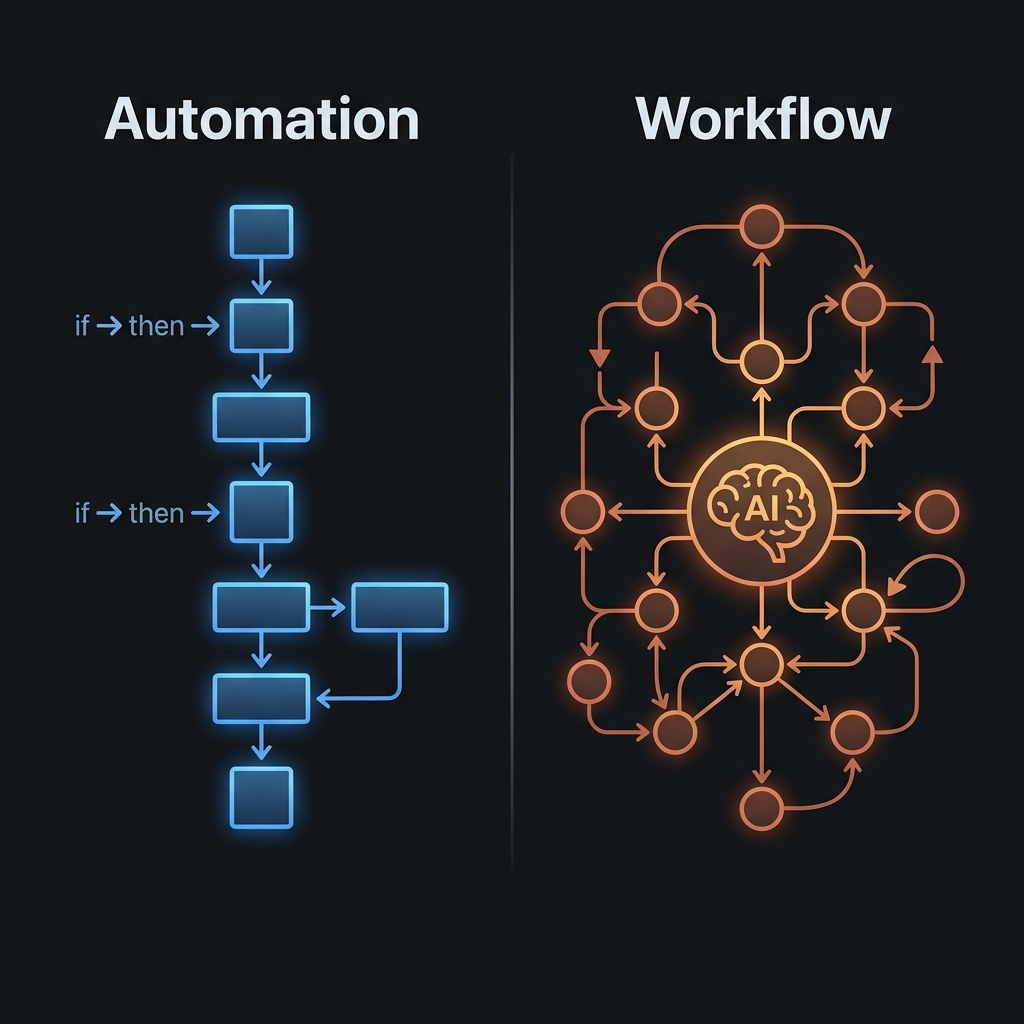
The core difference: Automation executes rules (if A, then do B). Workflow processes context (receive input, analyze, decide, take the appropriate action). Automation fits when rules are clear and stable. Workflow fits when you need flexible judgment case by case. For an SME just starting out: automation first, workflow when automation isn't enough.
You open Make.com and see a drag-and-drop interface. You visit an AI agent platform's website and see the word "workflow" everywhere. You read a tool review and see "automation" and "workflow" used interchangeably in the same paragraph.
Nobody tells you where they actually differ — because for tool vendors, that confusion works in their favor.
This post lays it out plainly.
Real-world definitions — not textbook definitions
AI Automation
What it is: A chain of actions triggered automatically by fixed rules, which may include AI at one specific step (e.g., classifying emails, summarizing text).
Characteristics:
- Fixed logic: if X, then do Y
- Doesn't adapt to context on its own
- Set up once, runs indefinitely (with periodic maintenance)
- Fits clean data and stable rules
Real examples:
- When a form is submitted → send a confirmation email → add to a Google Sheet → notify sales on Slack
- When a blog post is published → automatically post to Facebook + Twitter using a caption template
- Every Monday at 8am → pull Google Analytics data → send a summary report email
AI Workflow (Agentic Workflow)
What it is: A chain of processing steps where AI doesn't just perform actions but also participates in analysis, decision-making, or generating new output based on context — potentially with loops, dynamic branching, and human gates.
Characteristics:
- Flexible logic: AI decides the next step based on the input's content
- Can handle inconsistent input (customer emails, natural-language questions, varied documents)
- Requires more careful architectural design
- Fits when rules alone can't describe every case
Real examples:
- Receive a support request email → AI classifies the request type → looks up the knowledge base → drafts a reply → human review → send
- Receive a client brief → AI researches context → outlines → drafts content → human edits → approves → publishes
- Receive raw financial reports → AI analyzes trends → generates insights → highlights anomalies → human review → sends to stakeholders
A practical comparison table
| Criteria | AI Automation | AI Workflow |
|---|---|---|
| Processing logic | Fixed rules | Flexible AI judgment |
| Suitable input | Structured, consistently formatted data | Inconsistent data, natural language |
| Setup complexity | Low–Medium | Medium–High |
| Maintenance | Low — stable after setup | Higher — needs periodic review |
| Cost | Lower | Higher (more API calls) |
| When to use | Rules are clear, stable, repetitive | Requires judgment, varied context |
| Common tools | Make.com, Zapier, n8n | n8n + LLM API, LangChain, custom agents |
Why Vietnamese SMEs get this wrong — and the consequences
The most common mix-ups:
1. Calling automation "AI workflow" to sound more advanced
When you set up Make.com to send a trigger-based email automatically — that's automation. Not workflow. There's nothing wrong with that, but calling it by the right name keeps your expectations accurate and helps you pick the right tool.
2. Trying to build "AI workflow" when simple automation is enough
An SME wants to automatically add leads from a Facebook form to a Google Sheet and send a welcome email. That's a simple 3-step automation. No AI workflow, no agent framework, no LLM API needed. Make.com Free is enough.
But after reading too many posts about "AI agents" and "agentic workflows," they try to build something far more complex than necessary — it takes weeks and fails.
3. Expecting workflow flexibility but building with rigid automation logic
The opposite case: an SME wants AI to automatically classify and respond to customer requests based on context. That needs workflow, not automation. But they build it in Make.com with hard if/else rules — the result is a system that can't handle 40% of real-world cases.
Decision framework: Automation or Workflow?
Answer 3 questions:
Question 1: Is your input structurally fixed?
- Yes (form data, a structured spreadsheet, a webhook with a clear schema) → Automation
- No (natural-language emails, customer questions, varied documents) → Workflow
Question 2: Can the processing logic be fully described with if/else rules?
- Yes → Automation
- No (needs contextual judgment, too many edge cases) → Workflow
Question 3: Does the output require AI to generate new content?
- No (just moving data, transforming data, sending notifications) → Automation
- Yes (writing emails, analysis, summarizing, classifying based on context) → Workflow (or Automation + 1 AI step)
The real-world hybrid: Automation + an AI step
In practice, the best solution for many use cases is a hybrid — an automation framework with 1–2 specific AI steps:
[Trigger: New email from a customer]  ← Automation trigger
        ↓
[Filter spam/internal]                ← Automation rule
        ↓
[AI: Classify request type]           ← AI step (LLM call)
        ↓
[Route to the correct queue]          ← Automation rule
        ↓
[AI: Draft a preliminary reply]       ← AI step (LLM call)
        ↓
[Human: Review + send]                ← Human gate
This isn't purely "AI workflow." It isn't purely "automation" either. It's a hybrid — and for many SMEs, this is the best balance between complexity and effectiveness.
Go deeper — based on where you are
If you want to start with automation the right way:
- Business Process Automation: Where to Start, No IT Required
- AI Workflow Without Code — The Real Limits of No-Code Sắp ra mắt 17/07
If you want to understand more complex workflow architecture:
- AI Workflow for Vietnamese Businesses — A Real-World Architecture
- When an AI Workflow Actually Needs a Human Operator Sắp ra mắt 24/07
Where are you — automation or workflow — and are you using the right solution for the right problem?
In an Audit session, I'll look at your specific use case and point out: does this problem need automation or workflow, which tool actually fits, and the leanest architecture to solve it correctly.
FAQ
Are Zapier and Make.com "AI workflow" tools?
Not in the full sense. Both are automation platforms — they connect apps and trigger actions based on rules. They can include a step that calls an AI API (like ChatGPT or Claude), but the platform itself is an automation framework. A true "AI Workflow" requires AI to participate in judgment and decision-making within the flow, not just one API-calling step.
Is n8n a workflow tool?
n8n is a highly extensible automation tool. It can be used to build simple automations and more complex workflows (when combined with an LLM API and flexible flow design). n8n isn't an "AI workflow tool" by default — it depends on how you use it.
What is "agentic workflow" and how is it different from a regular workflow?
Agentic workflow is a workflow where an AI agent decides the next step itself based on the previous step's result — not a rigidly pre-written sequence. The agent can call tools, look up information, and repeat steps when needed. This is a higher level of complexity, suited for use cases that require complex reasoning. For an SME just starting out: automation → hybrid → workflow → agentic workflow, in that order.
Do I need to learn to code to build a hybrid workflow?
Not necessarily. Make.com can build hybrid workflows (automation + AI step) entirely no-code. So can n8n cloud. Coding becomes necessary when you want deep customization, self-hosting, or integration with complex internal systems.
Khám Phá Kho Workflow & SOP AI Thực Chiến
Thư viện quy trình, SOP vận hành và công cụ AI tôi đang dùng thật cho hệ thống của mình — chọn đúng thứ bạn cần.