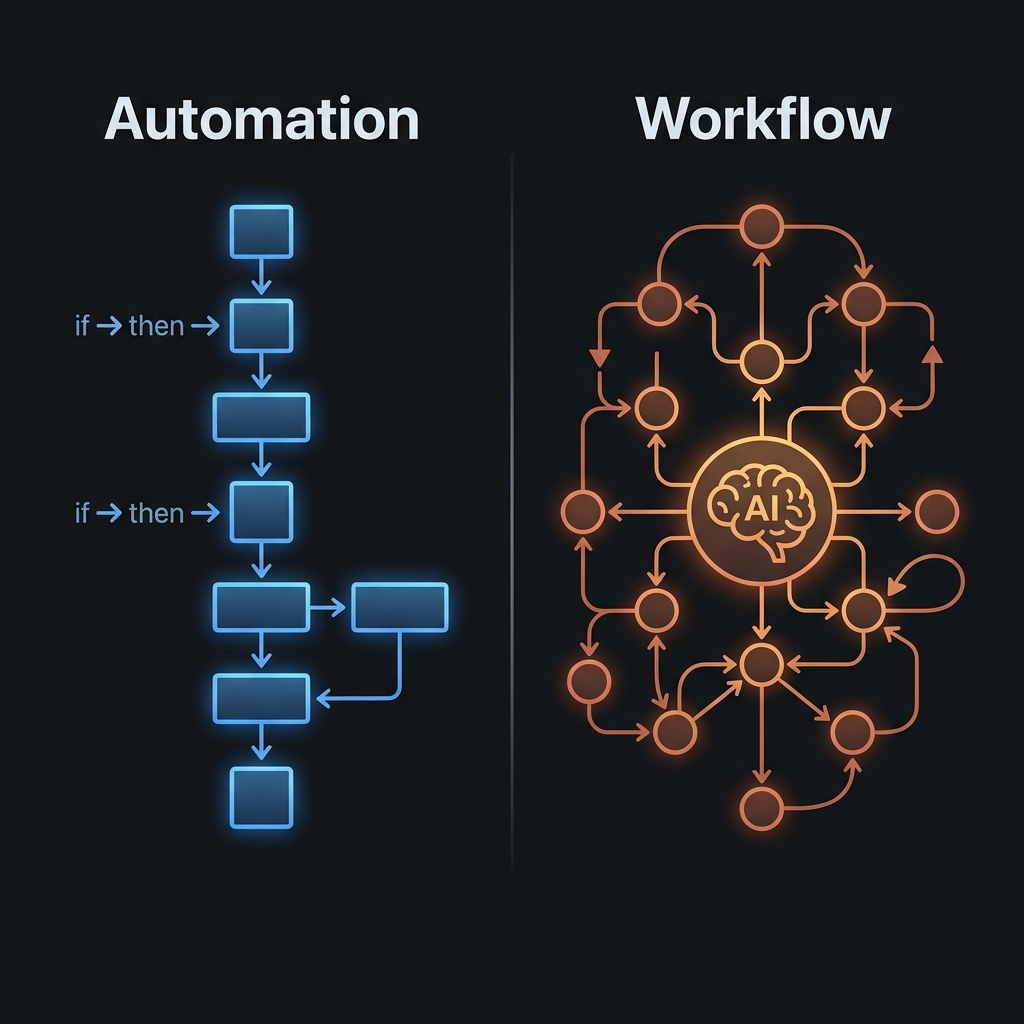
What Is the Director Mindset? The Core of AI System Design
The Director Mindset isn't about being better at using AI. It's a completely different way of seeing your role as the designer of a system when you work with AI.

What Is the Director Mindset? The Core of AI System Design
TL;DR: The difference between an ordinary AI user and someone who actually builds AI systems comes down to the Director Mindset. Instead of hunting for a better prompt for each individual tool, this mindset focuses on designing, controlling, and optimizing an entire automated data flow to solve a business's core operational problems.
What is the Director Mindset in applied AI?
Direct answer: The Director Mindset is the thinking of a systems designer who orchestrates autonomous operational processes with AI, rather than the thinking of someone directly operating disconnected tools. Instead of constantly asking "what can this AI do?", someone with a Director Mindset asks "what would this operational problem look like if it were designed to run fully automatically?" This is the turning point that shapes a business's technology leadership capability.
The problem: dependence on tools, and courses that teach the wrong direction
Most AI tutorials and training programs on the market today focus on teaching skills for using specific tools (tool-centric training). Learners are taught how to write a prompt so ChatGPT writes a better email, how to use Midjourney to make prettier images, or how to configure a specific platform's newly released features.
The result of this kind of training is that learners only become better tool users (advanced tool users). They stay stuck in a manual workflow: open a browser tab, type a prompt, wait for the result, copy it to another tab to keep processing. This workflow creates total dependence on each individual tool. When that tool changes its policy, raises its price, or updates its algorithm, the individual's and the business's entire output takes a serious hit.
This dependence comes from a business lacking an overall systems-design mindset to connect tools into a long-running automated flow that doesn't need constant human intervention.
Reframe: the difference between a great driver and a traffic-system designer
To really understand the Director Mindset, compare two specific roles in traffic: the great driver and the traffic-system designer.
- The great driver: They understand the vehicle they're operating, shift gears smoothly, know how to dodge potholes, and react extremely fast to unexpected situations. They can get you to your destination quickly on a specific trip.
- The traffic-system designer: They don't sit behind the wheel. Their role is to stand above it all, analyze traffic density to decide which roads need to be built, which lanes are reserved for buses, where to place roundabouts and traffic signals, and how to configure surveillance cameras to automatically catch violations.
In the AI era, if you only focus on learning prompts so AI writes content faster, you're playing the role of a great driver. Your business doesn't need more individual drivers; it needs a founder who plays the role of a traffic-system designer, building automated data pipelines that run continuously, 24/7.
Framework: 3 core traits of the Director Mindset
Someone with a Director Mindset always approaches automation problems through these 3 unchanging design principles.
1. Look at the workflow before looking at the tool
When facing a problem in the business, a Director's first reflex isn't to open Claude or ChatGPT. Their first reflex is to redraw the current process, by hand or in a mind-mapping tool. They clarify:
- Where does the input data come from, and in what format?
- How many processing steps does the current process have, and which specific people carry them out?
- What quality standard does the output need to meet? Only once the raw process has been cleaned up and its logic standardized does the Director move on to choosing the AI tool best suited to replace people at the automatable links.
2. Design the failure mode before building the success path
Most people building a workflow assume AI will always return the correct result 100% of the time. The Director Mindset works in reverse: they assume AI will, at some point, return a wrong result or hit an API connection issue. Before hitting the button to launch the system, they always design safety nets and error-handling processes in advance:
- If AI returns garbage data, how does the system automatically catch the error and request a fix?
- Where should the human checkpoint sit to review information before it goes out?
- If the workflow breaks, who receives the alert, and what's the fallback process?
3. Measure results with real time, not with a feeling
A Director doesn't care about vague comments like "this AI-written post feels faster to produce." They demand specific, quantifiable metrics:
- How many total hours does the team save per week after adopting this workflow?
- What's the API cost per completed task?
- What percentage of cases still need manual human correction? These numbers are the only real basis for evaluating an AI project's actual ROI.
Practical guide: 3 exercises to build the Director Mindset
Founders and managers can start training this systems-design mindset today with 3 simple practical exercises below.
Exercise 1: Write out the manual process by hand (paper run)
Pick a task that repeats weekly in your department (e.g., reconciling new leads from a signup form).
- Action: Don't open any AI tool at all. Use pen and paper to draw out each step of handling that task in detail, including the logical decision points (what happens if it's an A-quality lead, what happens if it's a B-quality lead).
- Goal: Clearly identify the raw data structure and train your logical thinking before bringing AI in to orchestrate it.
Exercise 2: Design an "AI is on vacation for a week" scenario
- Action: Ask yourself a hypothetical question: "If OpenAI's and Anthropic's entire API systems went down for a week, how would your business's operations be affected, and how would staff handle it manually instead?"
- Goal: Help you clearly see the dangerous dependency points in your system architecture and build safe backup plans.
Exercise 3: Set your metrics and baseline numbers before choosing a tool
- Action: Before installing any new AI software, have staff record exactly how many hours they spend on that task manually, for two consecutive weeks, as your baseline. Set a specific target: the new workflow must cut that time by at least 50% within a 30-day trial run.
- Goal: Train a management mindset based on real evidence, and avoid the trap of wasting time trialing tools that don't actually help.
Conclusion
The Director Mindset is the most important shift that takes a founder from someone chasing technology to someone who owns and builds the operating infrastructure of the new era.
If you're starting to apply AI in your business and want to set up a properly structured automation system from day one, the post below is your next step:
➔ 3 Questions I Ask Before Handing Anything to AI
You can also dig deeper into the technical architecture of automated data flow in Agentic Workflow Architecture: The Difference Between Ad-Hoc AI Use and Synchronized Automation Infrastructure.
#DirectorMindset #AISystemDesign #AIThinking #Founder #AIWorkflow
Khám Phá Kho Workflow & SOP AI Thực Chiến
Thư viện quy trình, SOP vận hành và công cụ AI tôi đang dùng thật cho hệ thống của mình — chọn đúng thứ bạn cần.